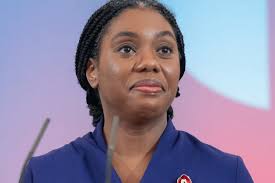
Tory Leader’s Comments Ignite Conversation on Race, Citizenship, and Belonging
Kemi Badenoch, the leader of the UK’s Conservative Party and one of the most prominent Black politicians in Britain, has made headlines for publicly stating that she no longer considers herself Nigerian—despite growing up in Nigeria and maintaining strong family ties to the country.
In a revealing conversation on the Rosebud podcast, Badenoch shared personal reflections on identity, belonging, and her decision not to renew her Nigerian passport in over two decades. Her comments are already stirring intense discussion both in the UK and Nigeria, especially among diasporic communities and political commentators.
“I’m Nigerian Through Ancestry, But Not By Identity”
A Personal Detachment Rooted in Experience, Not Rejection
Badenoch was born in London in 1980 but spent most of her childhood and teenage years in Nigeria and the United States before returning to the UK at age 16. Despite these deep cultural ties, she was unequivocal in her statement:
“I’m Nigerian through ancestry, by birth, despite not being born there because of my parents, but by identity I’m not really. I know the country very well, I have a lot of family there… But home is where my now family is.”
The “now family,” as she defines it, consists of her husband, children, in-laws, and even the Conservative Party—an institution she refers to as her “extended family.”
Her choice to frame British conservatism as part of her core identity, while distancing herself from her Nigerian roots, has drawn both support and criticism across political and cultural lines.
Citizenship by Chance
British by Law, Not Design
Badenoch’s British citizenship was not the result of careful planning, but rather historical timing. As she explained:
“Finding out that I did have that British citizenship was a marvel to so many of my peers.”
She was among the last individuals to automatically qualify for UK citizenship by virtue of being born in Britain—just before Prime Minister Margaret Thatcher abolished jus soli (birthright citizenship) in 1981.
Badenoch described this discovery as pivotal. For her parents, it represented a lifeline out of what they viewed as an unstable and unpromising future in Nigeria.
A Political and Economic Exodus
The Real Reason She Left Nigeria at 16
Badenoch’s decision to relocate to Britain was not a matter of preference—it was, according to her, one of necessity.
“I think the reason that I came back here was actually a very sad one, and it was that my parents thought: ‘There is no future for you in this country.’”
She moved in with a family friend in the UK to complete her A-levels as Nigeria struggled with economic instability and growing insecurity. It was during this transitional period that Badenoch began forming the British identity she now fully embraces.
A Complicated Relationship with Her Homeland
Travel “Fandango” and Government Clashes
Despite maintaining extended family connections in Nigeria, Badenoch hasn’t traveled there freely. She disclosed that when her father, Dr. Femi Adegoke, passed away in 2022, she had to obtain a visa to visit.
“It was a big fandango,” she said, describing the bureaucratic hassle involved.
Her comments about Nigeria have not gone unnoticed by its government either. Last year, Nigerian Vice President Kashim Shettima reportedly rebuked her after she spoke about corruption in the country. Shettima even suggested she “remove the Kemi from her name” if she no longer identified with Nigeria.
Badenoch has also frequently spoken about growing up in an environment shaped by fear and dysfunction, adding further strain to perceptions of her among Nigerian political figures.
Defending Britain, Dismissing Racism Claims
“People Didn’t Treat Me Differently”
Perhaps most striking was Badenoch’s assertion that she has not experienced racism in Britain “in any meaningful form”—a statement that directly counters the lived experiences of many ethnic minorities in the UK.
“I knew I was going to a place where I would look different to everybody, and I didn’t think that that was odd.”
Instead of discrimination, she says she encountered acceptance. This has made her a vocal defender of Britain in the face of accusations of systemic racism. Her stance has frequently aligned her with the Conservative right, which often pushes back against “woke” identity politics.
Badenoch’s views remain divisive—hailed by supporters as refreshingly honest and attacked by critics as erasing valid struggles.
Political Strategy or Personal Truth?
Identity as a Conservative Brand
Whether Badenoch’s identity statements stem from authentic belief or strategic positioning is a matter of debate. Some observers argue that her stance is in line with a broader conservative narrative that prioritizes national loyalty, traditional family values, and institutional pride over ethnic or diasporic solidarity.
Her framing of the Conservative Party as “family” reinforces this view—placing British political ideology above ancestral or cultural allegiance.
Others argue that her approach risks alienating young Britons of color who look for public figures who reflect their hybrid identities, rather than disown them.
The Bigger Picture: Identity in the Age of Global Politics
What Badenoch’s Comments Reveal About Belonging
Badenoch’s declarations tap into a wider conversation about what it means to belong—especially for individuals straddling multiple cultures.
In an era where identity politics often dominate discourse, her statements offer a counter-narrative: one that privileges civic identity and political alignment over ethnicity or birthplace.
But for many, her comments also raise difficult questions: Can you fully divorce yourself from the land of your upbringing? And if so, at what cost—to personal authenticity, to community representation, and to geopolitical diplomacy?
A Defining Moment for a Rising Leader
As Kemi Badenoch positions herself as a potential future Prime Minister, her views on race, nationality, and identity will undoubtedly face greater scrutiny. Whether this interview strengthens her political brand or erodes trust among multicultural constituents remains to be seen.
But one thing is certain: in distancing herself from her Nigerian heritage, Badenoch has ignited a conversation far bigger than politics—one that speaks to how we define identity in an increasingly globalized world.